Tensions in the Middle East Enter a New Phase
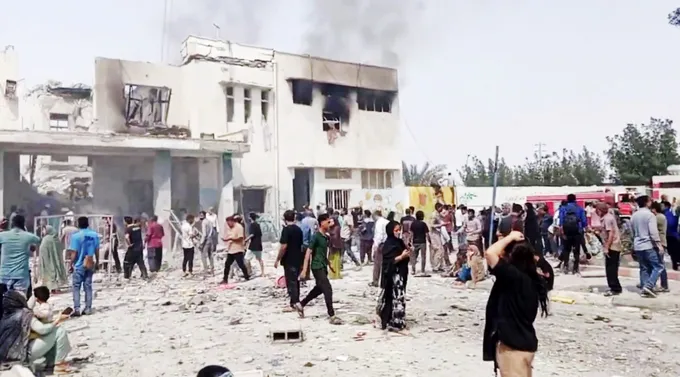
On February 28, a large-scale conflict erupted in the Middle East after the US and Israel launched a series of airstrikes targeting Tehran and other Iranian cities. Immediately afterward, Iran retaliated by launching dozens of ballistic missiles and drones against Israel and attacking US military bases in the region.
A Fierce Outrage
The attacks targeted government facilities and strategic military targets in Iran, including the homes of ministers, military commanders, the Ministry of Defense headquarters, and the presidential palace complex. Iran’s IRNA news agency reported that missiles landed in several areas of Tehran and the cities of Qom, Isfahan, Kermanshah, Karaj, Urmia, and Bushehr – home to the Bushehr nuclear power plant. The semi-official Fars news agency reported that at least seven missiles struck a security complex in the Pasteur district, home to the office of Supreme Leader Ali Khamenei.
The US War Department said Washington has named the large-scale airstrike campaign against Iranian military targets Operation Epic Fury. In a video posted on February 28, President Donald Trump stated that the US had launched a major military operation targeting Iran’s naval and missile forces.
According to US Senator Jack Reed, the senior Democratic member of the Senate Armed Services Committee, the Trump administration has not provided adequate intelligence to Congress, has barely mentioned the Iran issue in its 2026 State of the Union address, and President Trump has not clearly stated the objectives of the military action.
Shortly afterward, the Iranian Islamic Revolutionary Guard Corps (IRGC) launched a counterattack into Israeli territory. The Israeli military said missiles aimed at northern and central Israel were intercepted by Patriot systems. The semi-official Fars news agency reported that US military bases in Qatar, Kuwait, the UAE, and the headquarters of the 5th Fleet in Bahrain were also targeted, prompting several Gulf states to activate their air defenses.
Following a series of retaliatory attacks across the Middle East, in a second statement issued on the afternoon of February 28, the IRGC announced the launch of Operation “Truthful Promise-4” and the continuation of missile and drone attacks against US and Israeli forces. The IRGC also claimed to have destroyed a US FP132 radar system with a range of approximately 5,000 km, deployed in Qatar and used to track ballistic missiles. There has been no independent confirmation from either the US or Qatar regarding this claim.
Israel Maintains Pressure
On the afternoon of February 28, the Israel Defense Forces (IDF) announced the completion of another large-scale airstrike targeting Iran’s “strategic” air defense systems, amidst ongoing attacks on infrastructure that Israel calls “Iranian regime” facilities. One of the main targets was the advanced SA-65 air defense system deployed in the Kermanshah area.
According to Channel 12, Israel is deploying a comprehensive operation. The IDF’s Internal Front Command stated that the joint US-Israel operation had been planned months in advance, with the initial phase expected to last four days. On February 28, the Israeli military ordered the mobilization of approximately 20,000 additional reservists, primarily from the Air Force, Intelligence Directorate, Internal Front Command, and Navy. This number supplements the approximately 50,000 reservists already on active duty.
Israel’s Mossad intelligence agency also immediately launched a Persian-language Telegram channel to provide live updates to the Iranian people, urging them to share images and videos to overthrow the government.
In a statement on February 28, the Iranian Foreign Ministry declared that this is a moment of great trial in the country’s history and called on the United Nations Security Council (UNSC) to take urgent action to counter the aggression of the US and Israel.
In response to the military developments between Israel, the US, and Iran, many countries in Asia and Europe have called for restraint, promoted dialogue, held emergency meetings, and implemented measures to protect their citizens in the Middle East. UN Secretary-General Antonio Guterres issued a statement calling for an immediate end to hostilities, warning of a wider regional conflict, and stating that the organization would meet later on February 28 local time.
Many airlines in Europe, Africa, and Asia have simultaneously announced the cancellation of flights to the Middle East after several countries in the region, such as Iraq, Qatar, the UAE, Kuwait, and Syria, closed their airspace due to US and Israeli airstrikes against Iran.
