Russia Intensifies Missile and Drone Attacks on Ukraine as NATO Expands Military Support

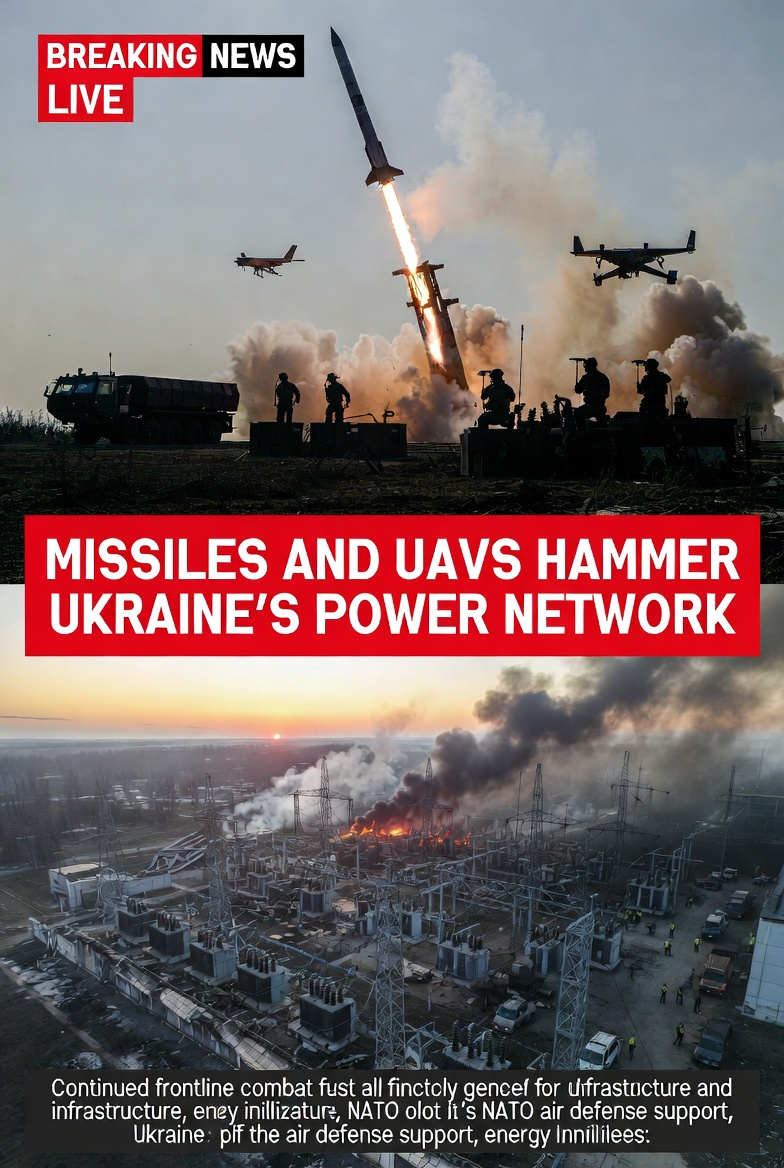
The war between Russia and Ukraine has entered a renewed phase of tension as Russian forces increase missile and drone strikes across Ukrainian territory, targeting key infrastructure while intense fighting continues along several strategic frontlines. Ukrainian officials say the latest wave of attacks has focused heavily on energy facilities, raising concerns about the stability of the country’s power grid and the broader security situation in Europe.
According to Ukrainian authorities, Russian forces launched multiple missiles and unmanned aerial vehicles in coordinated overnight operations against infrastructure sites linked to Ukraine’s energy network. Several regions reported explosions and air raid sirens as Ukrainian air defense units worked to intercept incoming threats. While some missiles and drones were reportedly shot down, damage to critical infrastructure has been confirmed in several areas.

Ukraine’s military said its forces remain engaged in fierce fighting along multiple strategic sectors of the front line, where both sides have been attempting to gain tactical advantages. The ongoing exchanges of artillery, missile strikes, and drone attacks illustrate how the conflict has evolved into a prolonged war of attrition.
Officials in Kyiv have repeatedly accused Moscow of attempting to weaken Ukraine’s energy system in order to disrupt civilian life and strain the country’s economy during the continuing conflict. Ukrainian energy authorities warned that repeated strikes on substations, power plants, and transmission facilities could lead to localized outages and further damage to infrastructure that has already faced heavy bombardment during the war.
At the same time, Ukraine continues to receive significant military assistance from Western allies. NATO members have expanded deliveries of weapons, ammunition, and advanced air defense systems designed to help Ukraine intercept incoming missiles and drones. Western officials say strengthening Ukraine’s defensive capabilities is essential to protecting cities and critical infrastructure from sustained aerial attacks.
NATO leaders have emphasized that the alliance’s support is intended to help Ukraine defend its sovereignty rather than escalate the conflict. However, Moscow has frequently criticized Western military aid, arguing that such support prolongs the war and increases geopolitical tensions between Russia and NATO countries.
Military analysts note that the use of drones and long-range missile strikes has become a defining feature of the conflict in recent years. These weapons allow forces to strike deep behind enemy lines, targeting logistics hubs, energy networks, and other critical infrastructure without requiring large-scale ground offensives.
Background
The Russia–Ukraine war began with Russia’s full-scale invasion of Ukraine in February 2022, dramatically escalating a conflict that had already been simmering since 2014 following Russia’s annexation of Crimea and the outbreak of fighting in eastern Ukraine.
Since the start of the invasion, the conflict has evolved through several phases, including large-scale armored offensives, counteroffensives by Ukrainian forces, and an increasingly heavy reliance on long-range missile and drone strikes. Both sides have suffered significant military losses, while millions of civilians have been displaced and large portions of infrastructure have been damaged or destroyed.
The war has also reshaped Europe’s security landscape. NATO has strengthened its military presence in Eastern Europe, while countries across the continent have increased defense spending and reconsidered their energy dependence and security policies.
Conclusion
As the conflict continues with no immediate resolution in sight, the latest escalation highlights the enduring intensity of the war and its far-reaching consequences. Continued strikes on infrastructure and ongoing frontline battles suggest that both Russia and Ukraine remain committed to pursuing their military objectives.
International observers warn that the prolonged conflict will continue to test regional stability and global political relations. While diplomatic efforts to end the war have periodically been discussed, the current trajectory of fighting indicates that the conflict may remain a central security challenge for Europe in the foreseeable future.
